





Public universities across Texas are facing a growing recruitment problem, and professors say the cause is not pay, workload, or prestige. It is fear.
At a recent public hearing at the Texas Capitol, faculty members from institutions including Texas State University, Texas A&M University, and the University of Texas at Austin warned lawmakers that political pressure and inconsistent protections for free speech are driving academic talent away from the state. Qualified candidates, they said, are increasingly unwilling to risk their careers in an environment they view as unstable and punitive.
The hearing was hosted by Representative Donna Howard, who chairs the House Democratic Caucus Committee on Free Speech. According to Howard, the volume and urgency of testimony reflected a crisis that has been quietly building for years.
Recruitment Has Changed, Professors Say
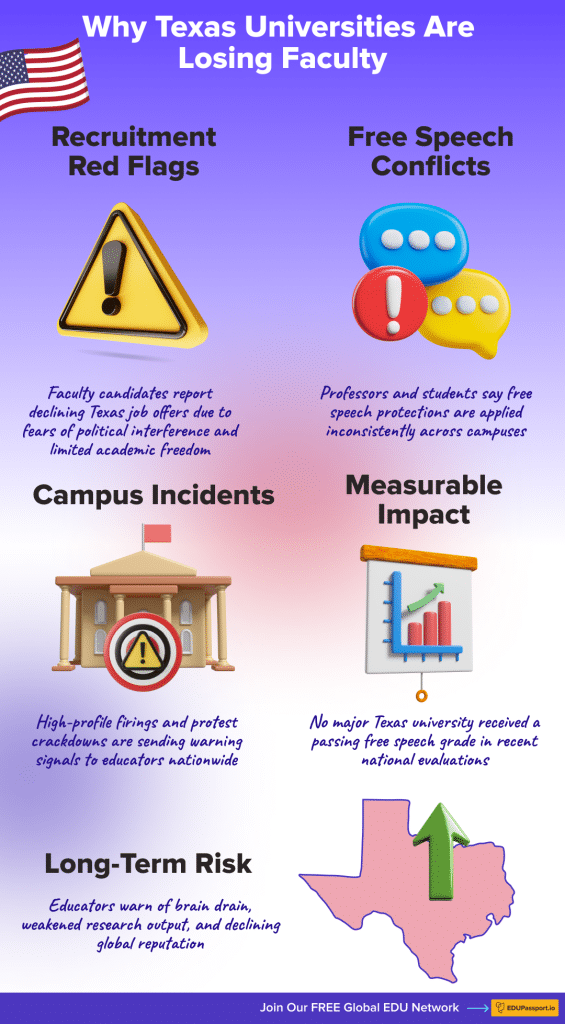
Texas State University professor Rolf Straubhaar told lawmakers that faculty recruitment conversations no longer begin with salary negotiations. Instead, candidates ask whether they can teach, research, and speak publicly without fear of retaliation.
“We’ve lost extraordinary candidates because of the political climate that exists here,” Straubhaar said. He described colleagues from across the country who admired Texas programs but ultimately declined to apply. “They told me directly, ‘I love what y’all do, but there’s no way I’m coming to Texas right now.’”
Straubhaar said the message from candidates is consistent. Academic freedom feels conditional, and employment appears vulnerable to political scrutiny.
Free Speech Under Pressure

Much of the concern centers on how free speech policies are enforced on Texas campuses. Witnesses argued that protections are applied unevenly, with some viewpoints tolerated and others punished.
Howard pointed to a series of recent incidents, including the firing of a Texas A&M professor after a classroom discussion on gender identity went viral online. The episode ultimately led to the resignation of the university’s president and intensified fears that political pressure can override academic judgment.
Howard also cited student protests following the assassination of conservative activist Charlie Kirk. She said students across the political spectrum expressed grief or criticism, but instead of defending students’ right to express opposing views, state leaders pressured university administrators to silence them.
“Both groups of students have every right to express themselves,” Howard said. “But political leaders called on university presidents and boards to use their powers to silence and expel students.”
Recent legislation has further complicated the landscape. Senate Bill 2972, passed earlier this year, restricted when and where demonstrations can take place on public campuses. The law removed language that previously designated outdoor campus spaces as open forums for expressive activity.
Students at the University of Texas at Austin and the University of Texas at Dallas have challenged the law in court. Earlier this month, a judge issued a temporary injunction blocking enforcement while the case proceeds.
Campus Climate and Fear
Testimony at the hearing suggested that the impact of these policies extends well beyond protests. Representative Erin Zwiener described an aggressive law enforcement response to a pro-Palestine protest at the University of Texas last spring, which she said escalated tensions and disrupted students during finals week.
At Texas State University, the firing of tenured history professor Thomas Alter following remarks made at an off-campus conference became a flashpoint. Alter said an edited video of his speech circulated online, leading to his termination. Soon after, a student withdrew from the university after drawing national attention at a protest, followed by online harassment and threats.
“These are not isolated cases,” Straubhaar said. “People are being punished not for wrongdoing, but for becoming inconvenient.”
Civil liberties advocates warned that vague definitions of “incitement” and “disruptive speech” create confusion for both administrators and students. Andrew Hendrickson of the American Civil Liberties Union told lawmakers that offensive speech is often the most legally protected.
“The First Amendment matters most when the speech is most offensive,” he said.
Evidence of a Chilling Effect
Data presented in November by the Foundation for Individual Rights and Expression underscored these concerns. No major Texas university earned a passing grade for its free speech climate. Students reported fear of expressing controversial opinions and dissatisfaction with how campus leaders respond to protests and speakers.
Joey Fishkin, a law professor at UCLA who previously taught at the University of Texas, said the consequences are already visible. Young scholars, he said, are questioning whether Texas is a viable place to build an academic career.
“We can’t have great universities when governments or administrators micromanage what can and can’t be said,” Fishkin told lawmakers. “That danger is real, and it’s serious.”
Long-Term Risks for Universities
Educators warned that faculty departures will have lasting consequences. Research output may decline. Student learning environments may narrow. Institutional reputations could suffer, both nationally and internationally.
These risks come at a moment when U.S. higher education is already losing ground globally. As EDU News previously reported in America’s Global Classroom Is Quietly Shrinking, international student enrollment in the United States has been declining, driven by policy signals, safety concerns, and perceived hostility toward academic freedom. Instability at major public universities may accelerate that trend.
Several professors said they are already advising graduate students and early-career scholars to look elsewhere. Undergraduate and graduate students, including native Texans, are also considering leaving the state to continue their studies.
“People who can go elsewhere are going to go elsewhere,” Zwiener said. “That’s going to diminish the quality of our institutions for everyone.”
For faculty who testified at the Capitol, the warning was straightforward. Academic talent is mobile, and silence is not a sustainable recruitment strategy.
“It tells people their future in Texas is conditional,” Straubhaar said. “And many are deciding that the condition is too high a price to pay.”
Stories like this show how policy decisions shape real academic careers. On EDU Passport, educators and university professionals share insights on campus culture, hiring trends, and how higher education systems are changing across regions. You can join the conversation and explore more education news and perspectives by signing up for EDU Passport.
Source: Houston Press, “University Professors Say They Don’t Want to Teach in Texas.”