





For the first time in three years, the number of Indian students pursuing higher education overseas has declined. New data from India’s Ministry of External Affairs, presented to parliament in late 2025, shows that Indian outbound student mobility has slowed after a period of rapid post-pandemic growth.
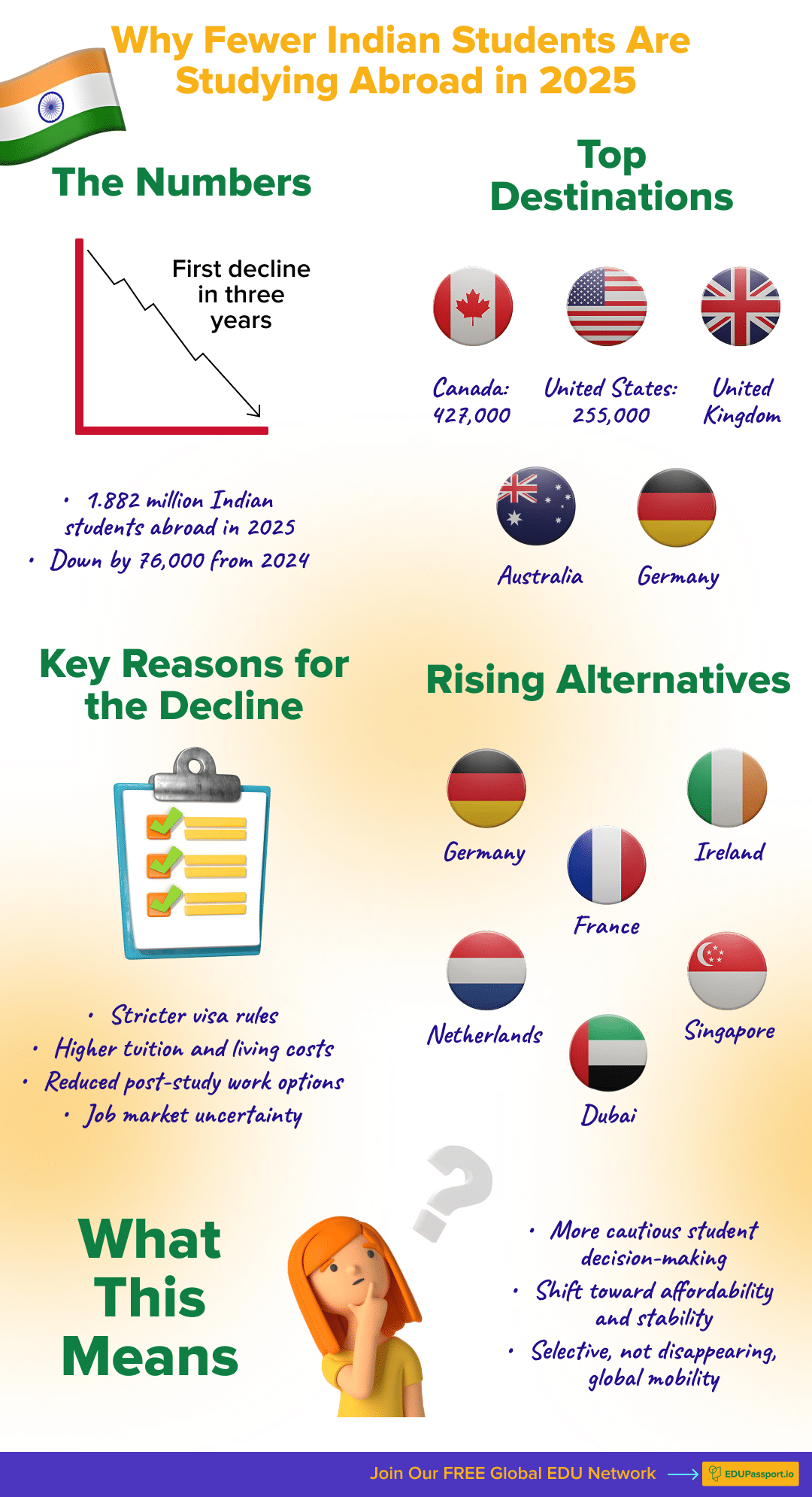
According to the data, around 1.882 million Indian students are currently studying across 153 countries. While that figure still places India among the world’s largest sources of international students, it represents a meaningful shift. In 2024, approximately 1.33 million Indian students were enrolled abroad. The 2025 numbers show a drop of roughly 76,000 students, ending a three-year upward trend that began in 2022.
The slowdown is not the result of a single factor. Instead, it reflects a combination of tighter immigration policies, rising financial pressure, uncertain job prospects, and growing geopolitical concerns that are reshaping how Indian families think about overseas education.
Where Indian students are still going

Despite the decline, traditional English-speaking destinations continue to dominate. Canada remains the top destination, hosting about 427,000 Indian students, followed by the United States with around 255,000. The United Kingdom ranks next, while Australia, Germany, Russia, Georgia, and Kyrgyzstan also attract sizable numbers.
However, the overall picture is changing. New enrolments in several major destinations have slowed, even as total student populations remain high due to students already mid-degree.
Education analysts say the downturn reflects a market correction rather than a collapse. Maria Mathai, founder of MM Advisory Services, told University World News that the 6.1% contraction signals a cooling after exceptional growth.
“Major English-speaking destinations maintain structural advantages that alternative destinations cannot yet replicate at scale,” she said, adding that high-quality postgraduate applicants continue to target countries such as Canada, the US, and Germany.
Visa policies reshape student decisions
One of the most immediate drivers of the decline has been policy tightening across popular study destinations.
Between 2022 and 2024, Indian students traveled abroad in record numbers, encouraged by generous post-study work options and clear migration pathways. In 2025, many of those incentives were scaled back.
Canada introduced stricter visa scrutiny, higher rejection rates, and new provincial attestation requirements. It also imposed caps on international student numbers, citing housing pressure and infrastructure strain. While Canada remains attractive, these changes have made applications more complex and costly.
The United Kingdom limited students’ ability to bring dependents and shortened post-study work opportunities, reducing its appeal for some postgraduate applicants. In the United States, reduced visa appointment availability, increased scrutiny, and ongoing uncertainty around work visas have forced many students to delay or abandon plans.
Australia also raised English language requirements and narrowed pathways to permanent residency, adding another layer of caution for prospective students.
According to Mathai, these changes reflect greater selectivity rather than outright exclusion. She noted that Canada’s enrolments have remained relatively stable compared to other destinations, suggesting a shift toward prioritizing applicant quality over volume.
Rising costs hit middle-class families hardest
Alongside policy changes, financial pressure has become a decisive factor.
Tuition fees have risen across major destinations, while global inflation has pushed up living costs. At the same time, currency fluctuations have made studying in the US, UK, and Canada significantly more expensive for Indian families.
Harish Goyal, a parent from New Delhi, told University World News that although his daughter plans to pursue postgraduate study in Canada, the country’s sharply increased proof-of-funds requirements have made the process far more challenging.
For many middle-class families, the return on investment is no longer guaranteed. Education consultants report growing hesitation among parents who worry that higher upfront costs may not translate into stable post-study employment.
Job prospects feel less certain
Employment outcomes remain the primary motivation for most Indian students studying abroad. In 2025, those prospects feel less predictable.
Competition for entry-level roles has intensified in the US and UK, particularly in sectors that once absorbed large numbers of international graduates. Work visa pathways are also less certain, making long-term planning difficult.
As a result, many students are questioning whether overseas degrees still justify the financial and emotional investment. This concern mirrors broader global trends. In the United States, for example, international student enrolment has quietly declined as policy uncertainty and affordability issues mount, a shift explored in detail in America’s Global Classroom Is Quietly Shrinking.
Geopolitics adds another layer of uncertainty
Diplomatic tensions have further complicated decision-making. Relations between India and Canada deteriorated after Canada accused the Indian government of involvement in the 2023 killing of Sikh activist Hardeep Singh Nijjar.
While official education ties remain intact, the dispute has heightened anxiety among students and parents. Concerns about personal safety, visa delays, and long-term policy stability have influenced choices, particularly for those considering permanent migration.
Consultants say this uncertainty has pushed some students to postpone applications or explore destinations perceived as politically neutral.
New destinations gain attention
As traditional pathways become more restrictive or expensive, Indian students are widening their options.
Germany has emerged as one of the most attractive alternatives, thanks to low or no tuition fees, strong technical programs, and solid employment prospects. Interest has also grown in France, Ireland, the Netherlands, and Sweden, as well as parts of Eastern Europe.
Some students are also looking closer to home, considering Dubai, Singapore, and other Asian hubs that offer clearer visa rules and lower overall costs. While these destinations cannot yet match the scale of North America or the UK, enquiry levels are rising steadily.
Interestingly, preferences within the so-called Big Four English-speaking countries have shifted. Despite earlier declines, the UK regained momentum in 2025, attracting students with shorter courses, relatively lower costs, free healthcare access, and high visa acceptance rates.
A pause, not a retreat
The decline in Indian students studying abroad does not signal the end of global education ambitions. Instead, it reflects a more cautious, calculated approach shaped by policy realism, financial constraints, and shifting global dynamics.
As governments reassess immigration frameworks and families weigh costs more carefully, international education is entering a more selective phase. For students, navigating this landscape requires better information, clearer pathways, and access to trusted global networks.
At EDU Passport, we track these shifts closely, sharing data, insights, and real opportunities across education systems worldwide. If you work in education or are exploring international study and career pathways, joining the EDU Passport community helps you stay informed, connected, and prepared for what comes next.
Source: University World News, “Indian students abroad: Numbers fall after three-year surge”