






The number of Indian students pursuing higher education overseas has declined for the first time in three years, marking a significant shift in global student mobility patterns.
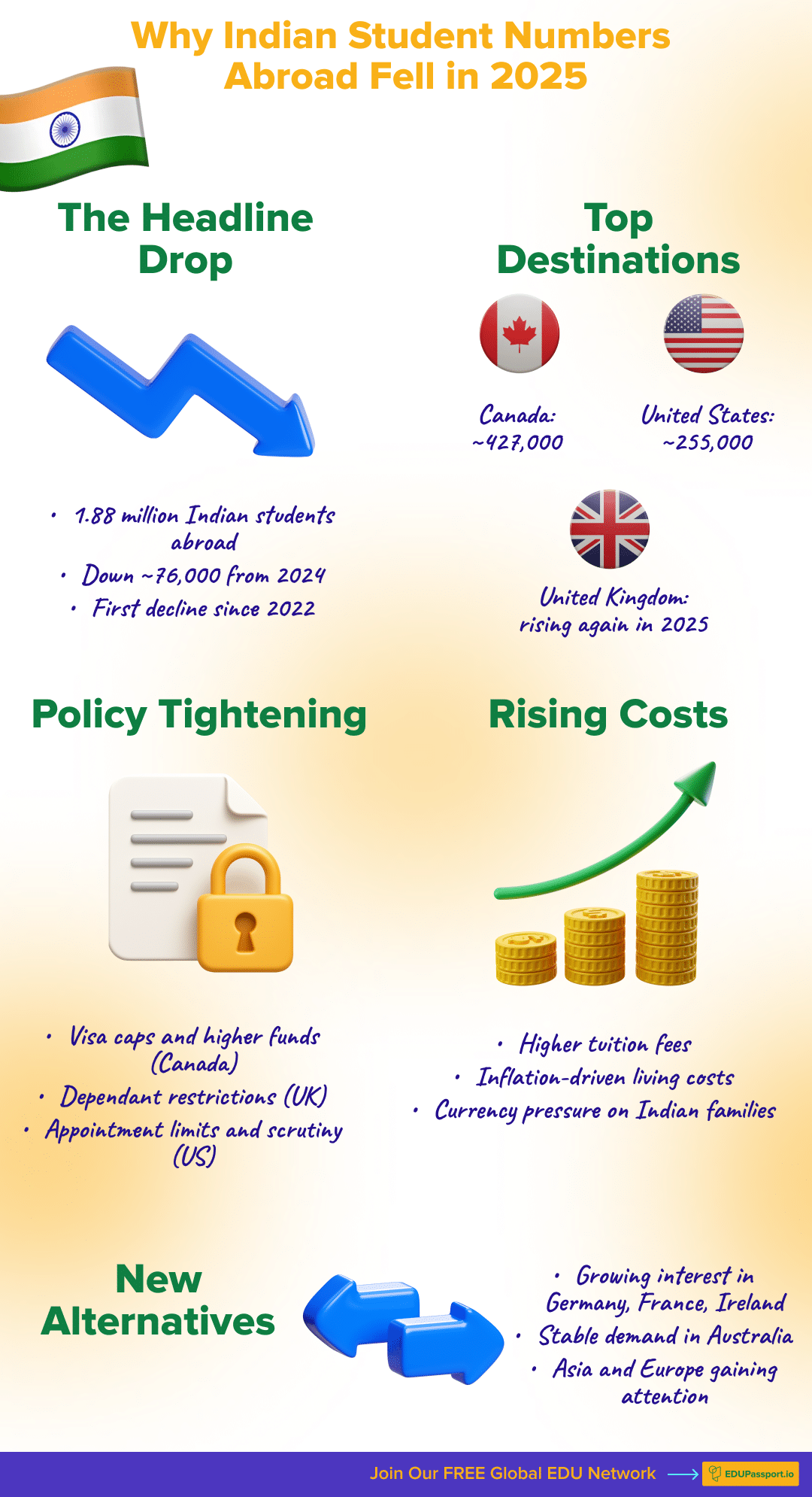
According to data released by India’s Ministry of External Affairs (MEA) to parliament, around 1.88 million Indian students are currently studying in 153 countries. While the headline figure remains high, the latest numbers show a clear slowdown after rapid growth between 2022 and 2024.
Of the total, 1.25 million students are enrolled in universities and other major higher education institutions. In 2024, the figure stood at approximately 1.33 million, meaning overseas enrolment has fallen by about 76,000 students in 2025.
The figures, first reported by University World News, signal a turning point after three consecutive years of expansion driven by strong post-study work opportunities, migration pathways, and pent-up demand following the pandemic.
Canada and the US still lead, but pressure grows
Despite tighter immigration controls, Canada remains the top destination for Indian students, hosting around 427,000 learners across all years of study. The United States follows with approximately 255,000 Indian students.
The United Kingdom remains the third most popular destination, while Australia, Germany, Russia, Georgia, and Kyrgyzstan continue to attract steady numbers of Indian students.
However, Canada’s position as the leading destination has come under strain. New visa scrutiny, higher rejection rates, caps on international student numbers, and increased financial requirements have slowed growth, even as overall enrolment remains high.
“The 6.1% enrolment contraction represents market correction following exceptional growth rather than systemic retreat from international education,” said Maria Mathai, founder of MM Advisory Services, in comments reported by University World News.
She added that major English-speaking destinations still retain “structural advantages” that alternative destinations cannot yet replicate at scale.
Visa policy changes reshape student choices

Education consultants say policy changes across major study destinations are playing a decisive role in the decline.
Between 2022 and 2024, Indian students travelled abroad in record numbers, encouraged by generous post-study work visas and long-term migration prospects. In 2025, those conditions shifted sharply.
- Canada introduced stricter financial thresholds, provincial attestation requirements, and caps on international student intake, citing housing pressures.
- The UK restricted the ability of international students to bring dependants and reduced post-study work options, particularly affecting postgraduate applicants.
- In the US, limited visa appointment availability, increased scrutiny, and rising rejection rates disrupted student plans.
- Australia tightened English language requirements and narrowed permanent residency pathways.
“Parents are worried, and many are waiting for the situation in the US to stabilise before making a decision,” said R Suresh Kumar, managing director of Chennai-based Truematics Overseas Education, speaking to University World News.
While interest is growing in countries such as France, Germany, Ireland, the Netherlands, Singapore, and the UAE, consultants note that these destinations still cannot match the scale of the US or UK.
Rising costs add to the pressure
Beyond visa rules, the financial burden of studying abroad has increased sharply.
Tuition fees have risen across major destinations, while inflation and currency fluctuations have pushed up living costs in countries such as the US, UK, and Canada.
“Studying abroad has become significantly more expensive for middle-class families,” said Harish Goyal, a parent based in New Delhi, whose daughter plans to pursue postgraduate studies in Canada. He noted that Canada’s higher proof-of-funds requirements have made applications more challenging.
At the same time, job prospects, a key motivation for most Indian students, have become more uncertain. Consultants report growing competition for entry-level roles, particularly in the UK and US, making it harder for international graduates to justify the rising investment.
Diplomatic tensions and shifting preferences
Diplomatic tensions have also influenced decision-making. Strained relations between India and Canada following allegations surrounding the 2023 killing of Sikh activist Hardeep Singh Nijjar have raised concerns among students about visa delays, safety, and policy stability.
As traditional destinations become less predictable or more expensive, Germany has emerged as a strong alternative, driven by low-cost education, strong technical programmes, and favourable employment conditions. Interest has also increased in parts of Europe and Eastern Europe, where visa rules are clearer and living costs are more manageable.
Within the English-speaking “Big Four”, preferences are also shifting. While Canada and the US have seen declines in new arrivals, the UK regained momentum in 2025, attracting students with shorter courses, lower overall costs, free healthcare access, and comparatively high visa approval rates.
For now, consultants expect uncertainty to persist. While demand may recover by 2026, 2025 marks a clear pause in what had been an unprecedented surge in Indian students studying abroad.
Tracking global education shifts matters more than ever.
Stay informed with EDU News for trusted reporting on international study trends, visa policies, and student mobility worldwide.