




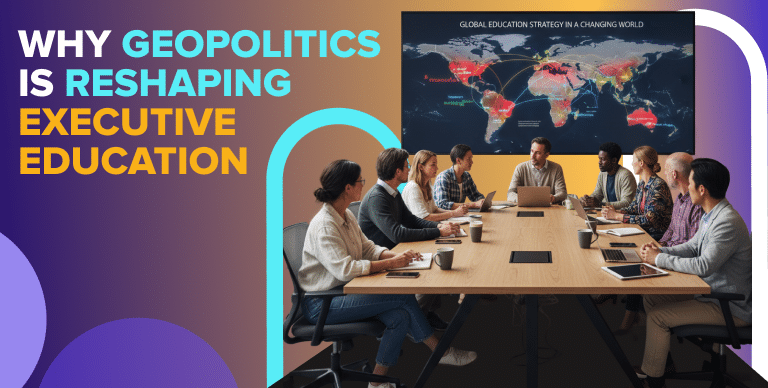

For decades, executive education focused on strategy, finance, leadership, and organizational management. Geopolitics was often treated as a specialist topic, relevant only to diplomats, analysts, or political scientists.
That assumption is rapidly changing.
In today’s global environment, business leaders are increasingly required to understand geopolitical risk, supply chain disruption, regional instability, and cross-border regulatory shifts. These are no longer external factors. They are core business variables.
As global conflicts intensify and economic fragmentation increases, executive education programs are being redesigned to reflect a more uncertain world.
From Business Strategy to Geopolitical Survival Skills
Modern leadership education is expanding beyond traditional corporate frameworks.
Business schools are now integrating geopolitical awareness into executive programs, recognizing that decisions in finance, operations, investment, and expansion are directly influenced by global instability.
Senior executives are no longer asking only how to grow markets. They are also asking how to maintain continuity in unstable environments, how to redesign supply chains under pressure, and how to operate across fragmented regions.
This shift signals a major transformation in leadership development. Strategy is no longer separate from geopolitics. It is embedded within it.
Business Schools Are Becoming Global Risk Intelligence Hubs
The role of business schools is evolving beyond education delivery.
Many institutions are now positioning themselves as knowledge centers for geopolitical analysis and corporate risk management. Executive programs increasingly include scenario planning, crisis leadership, economic fragmentation analysis, and cross-border regulatory strategy.
This reflects a deeper change in demand. Executives are not just seeking knowledge. They are seeking tools to interpret uncertainty and make decisions under pressure.
As a result, executive education is becoming more closely aligned with real-time global developments rather than static academic frameworks.
The Rise of “Learning in Crisis Environments”

One of the most significant developments in executive education is the idea of “learning in crisis environments.”
Institutions located in geopolitically sensitive regions are now seen as uniquely positioned to teach leadership under real-world pressure. Their proximity to instability provides a lived understanding of uncertainty that traditional academic environments cannot replicate.
This has created a new dimension in education value. Experience is no longer theoretical. It is contextual and immediate.
Global Fragmentation is Reshaping Executive Demand
Executives across industries are increasingly concerned with geopolitical fragmentation.
Decisions about where to invest, how to structure supply chains, and how to expand internationally are now influenced by political risk and regional instability. This has created rising demand for executive programs that focus on geopolitics, risk management, and global strategy adaptation.
Business schools are responding by launching new programs focused on multi-polar world systems, geopolitical risk analysis, and leadership in unstable environments.
This reflects a broader shift in how leadership is defined. It is no longer only about managing organizations. It is about navigating global complexity.
The Hidden Impact
This shift is not limited to executive education alone. It is reshaping the broader education ecosystem.
EDU businesses, corporate training providers, and education platforms are now operating in a market where demand is driven by global instability. Curriculum design, program delivery, and institutional partnerships must now account for geopolitical risk and regional differences.
For vendors and education partners, this also opens new opportunities. Demand for content, learning infrastructure, digital delivery systems, and cross-border education solutions is increasing as institutions expand globally and adapt to uncertainty.
Education is becoming more integrated with global economic and political systems than ever before.
What This Means for EDU Business and Global Learning Platforms
For EDU business stakeholders, this trend represents a structural shift in demand.
Education is no longer only about long-term academic development. It is also about immediate relevance to global conditions. Institutions must now deliver programs that help leaders interpret uncertainty and act decisively in fragmented environments.
For platforms like EDU Passport, this evolution highlights the importance of connecting educators, institutions, and business learners within a single global ecosystem. The demand is not just for talent or programs, but for access, visibility, and structured global connectivity.
Conclusion
Executive education is undergoing a fundamental transformation.
Geopolitics is no longer a peripheral topic. It has become central to how leaders are trained, how decisions are made, and how institutions design learning experiences.
As global uncertainty increases, the demand for education that can interpret complexity and guide decision-making will continue to grow.
In this new environment, the most valuable education systems will not only teach leadership theory but will also prepare leaders to operate in a world defined by instability, fragmentation, and constant change.
For EDU Passport, this shift reinforces the role of the education ecosystem as a global connector between knowledge, institutions, and the evolving needs of leadership in a geopolitical age.