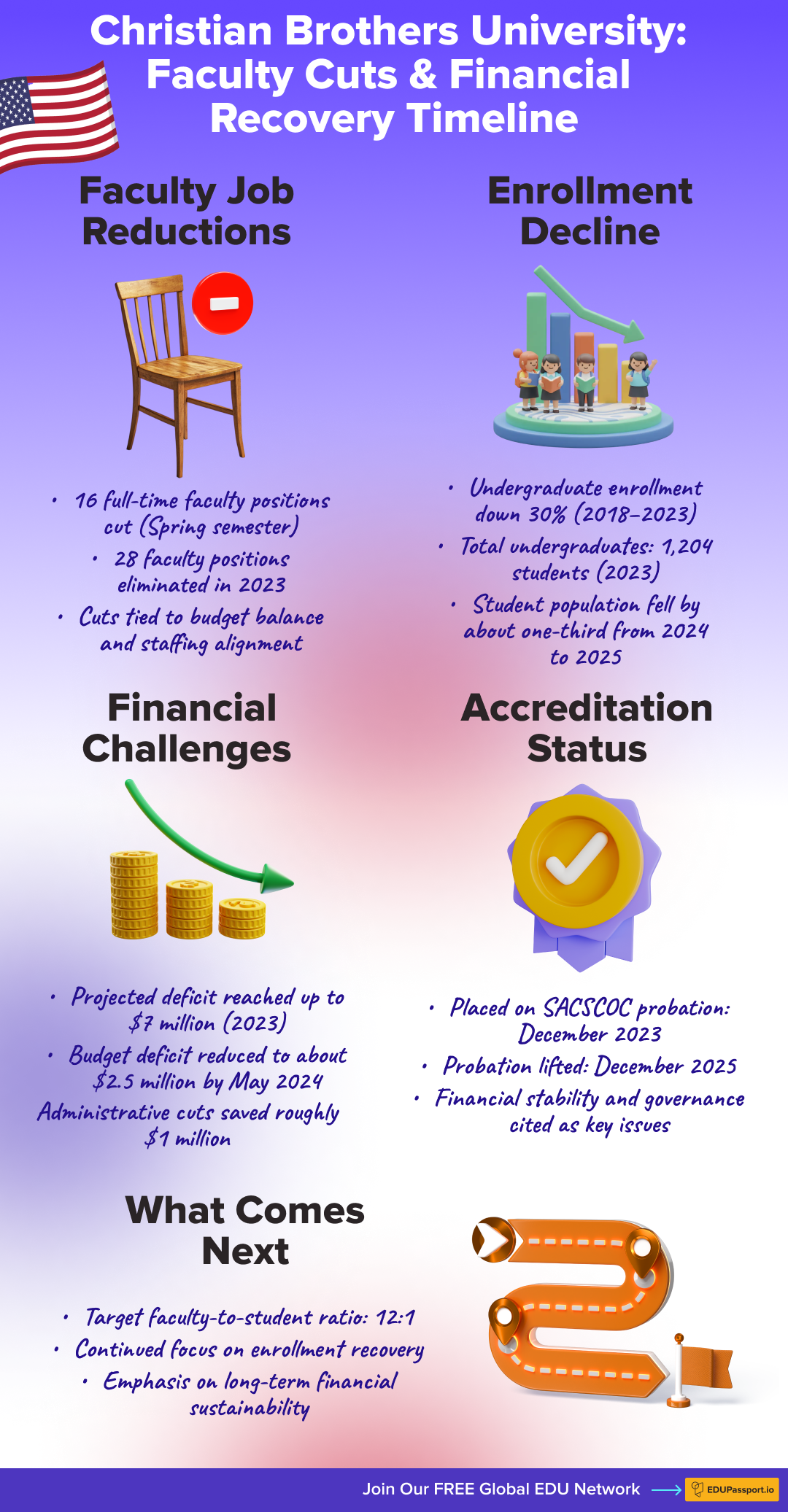





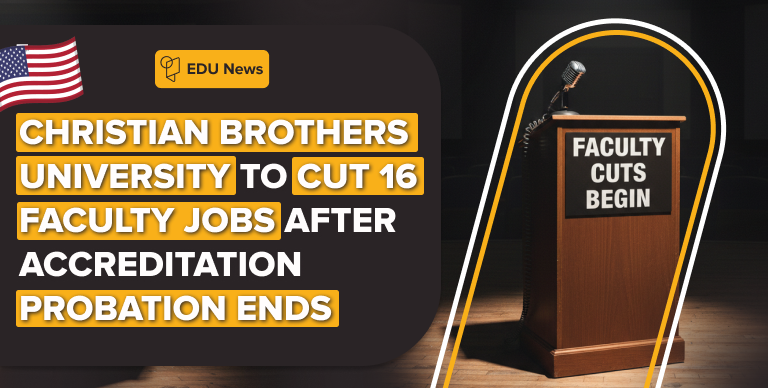
Christian Brothers University (CBU) has announced plans to eliminate 16 full-time faculty positions at the end of the spring semester as part of an ongoing effort to stabilize its finances and reshape the institution for the future.

Interim President Chris Englert said the decision is aimed at balancing the university’s operating budget and positioning CBU for long-term transformation. In a public message shared this week, Englert emphasized that no academic programs are being eliminated and that students will still be able to complete their declared majors with minimal disruption.
The announcement comes shortly after the private Catholic university in Tennessee emerged from a two-year accreditation probation. Earlier this month, CBU confirmed that the Southern Association of Colleges and Schools Commission on Colleges (SACSCOC) had lifted its probationary status, following significant cost-cutting measures and governance reforms. According to reporting by Higher Ed Dive, the probation had been imposed due to concerns about financial stability and board oversight, issues the university has worked to address over the past two years.
CBU’s financial challenges have been building for several years. In fall 2023, the university declared financial exigency as it faced a projected budget deficit of up to $7 million. That designation allowed the institution to lay off tenured faculty and scale back academic offerings, a step that often signals deep financial distress in higher education.
At the time, university leaders cited a consistent decline in undergraduate enrollment beginning in the 2018–19 academic year, along with missed first-time freshman enrollment targets for fall 2023. Federal data shows that undergraduate fall enrollment dropped by just over 30 percent between 2018 and 2023, falling to 1,204 students.
To reduce costs, the university cut several senior administrative roles in October 2023, a move that helped lower its deficit by about $1 million. Two months later, CBU eliminated 28 faculty positions through layoffs and unfilled vacancies and discontinued roughly a dozen low-enrollment programs, including English, history, ecology, and engineering physics, according to Higher Ed Dive.
By late 2024, university leaders struck a more hopeful tone. They reported increases in first-year enrollment and said the budget deficit had been reduced by nearly half, to approximately $2.5 million by May 2024. However, it took another year before SACSCOC officially removed the university from probation.
In a December 9 message announcing the accreditation decision, Englert described the outcome as an important milestone and credited faculty, staff, and trustees for their efforts. He also cautioned that continued academic and financial discipline would be essential to remain in compliance with accreditation standards.
That message was echoed again this week as Englert explained the latest faculty reductions. He said the cuts are part of a broader strategy to reach a faculty-to-student ratio of 12 to 1, align academic staffing with shifting enrollment patterns, and support long-term financial stability.
Despite recent progress, enrollment pressures remain a concern. Local reporting by the Daily Memphian indicates that the university’s student population declined by roughly one-third between 2024 and 2025, underscoring the challenges facing small private institutions as they navigate demographic shifts and rising operational costs.
Faculty changes and enrollment shifts are reshaping campuses worldwide. Join EDU Passport for FREE to explore verified teaching, academic, and leadership opportunities and stay connected to a global higher education network.