




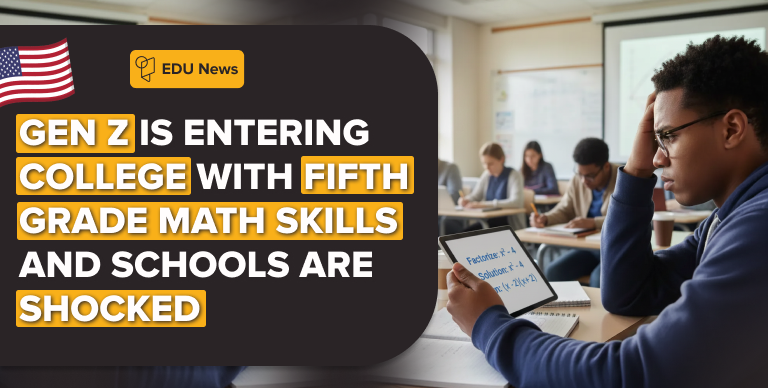

Colleges across the United States are reporting something they never expected to see at this scale. A rising number of Gen Z freshmen are starting college without the math skills they should have mastered years ago. A report highlighted by The New York Post shows many students testing below middle school level, with some placing at fifth grade proficiency.
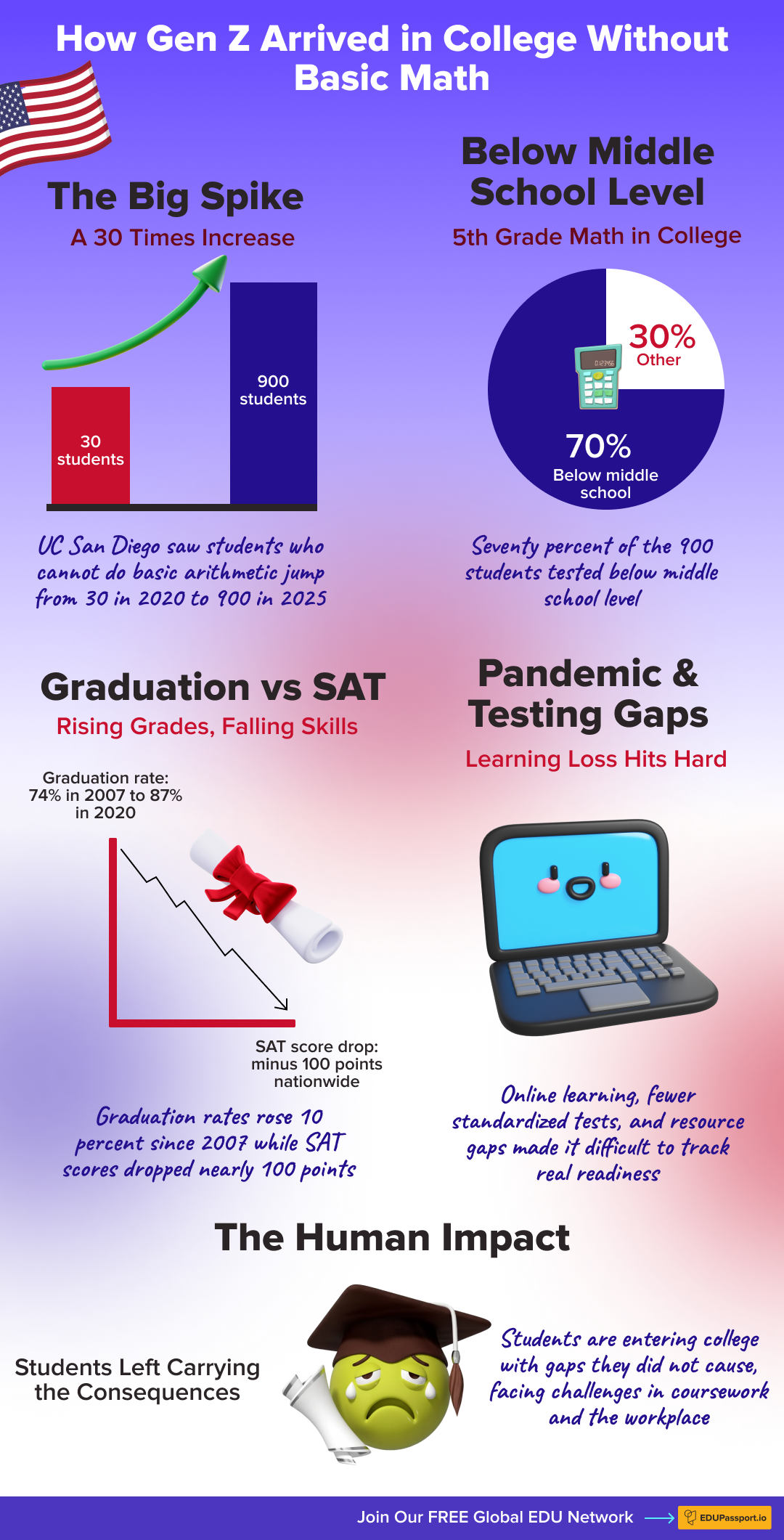
Graduation rates keep climbing, but SAT math scores keep falling. The mismatch is too big to ignore.
UC San Diego Sounds the Loudest Alarm
No campus illustrates the problem more clearly than the University of California San Diego. Faculty reported a thirtyfold increase in incoming students who cannot perform basic arithmetic compared to 2020.
Five years ago, 30 freshmen placed below high school level. This year, the number hit 900. That is one in eight incoming students at a selective university.
Even more concerning, seventy percent of those 900 students scored below middle school level. Faculty called the findings “truly troubling” and urged immediate institutional action.
How Did We Get Here
The report points to several factors that collided at the worst possible time.
Pandemic Learning Loss
This entering class spent a large portion of high school learning online, often without consistent math instruction.
The Decline of Standardized Testing
With many schools phasing out testing, it became harder to measure what students actually know.
Inequities in School Resources
Students from under-resourced schools often receive limited exposure to strong math instruction.
Widespread Grade Inflation
Perhaps the biggest factor is the quiet rise of grade inflation. Districts under pressure to improve graduation numbers often boosted grades instead of boosting learning.
This practice accelerated after the No Child Left Behind Act required states to track and raise graduation rates. As graduation rates climbed more than ten percent between 2007 and 2020, average SAT scores fell by nearly 100 points.
The Skills Gap Is Not Limited to Math
UC San Diego is not alone. Colleges across the UC system and nationwide report slipping proficiency in math, writing, and basic reasoning. Students are arriving with high GPAs and strong transcripts, but their foundational skills tell a different story.
The Real Impact Lands on Students
Experts warn that the system is failing the very kids it claims to help. When students move through school without mastering core skills, the consequences follow them well into college and the workforce.
As one education expert told The Post, “You cannot fool the workplace.” Employers eventually discover what grades tried to hide.
This same pattern shows up earlier in the pipeline too. States like Indiana are already seeing major literacy gaps. Our coverage, Why Thousands of Indiana Kids Are Repeating Third Grade and What Hope Looks Like Next, explores how early reading struggles often predict the same challenges later seen in math readiness. These issues do not start in high school. They start in elementary school.
A Call for Immediate Action
UC San Diego faculty concluded their study with a direct message. Schools need to rethink how they measure mastery, how they assess growth, and how they support learning from elementary grades through college. Until that happens, campuses will continue welcoming freshmen who look prepared on paper but are quietly struggling with skills they should already have.
This moment is a reminder that educators everywhere are facing the same questions about readiness, equity, and what real learning looks like. If you want to stay connected with other educators who are navigating these challenges, sharing strategies, and building stronger classrooms together, join EDU Passport. It is a supportive space to learn from one another, exchange ideas, and stay ahead of the issues shaping education today.
Sign up for free and be part of a community working to lift students at every level.