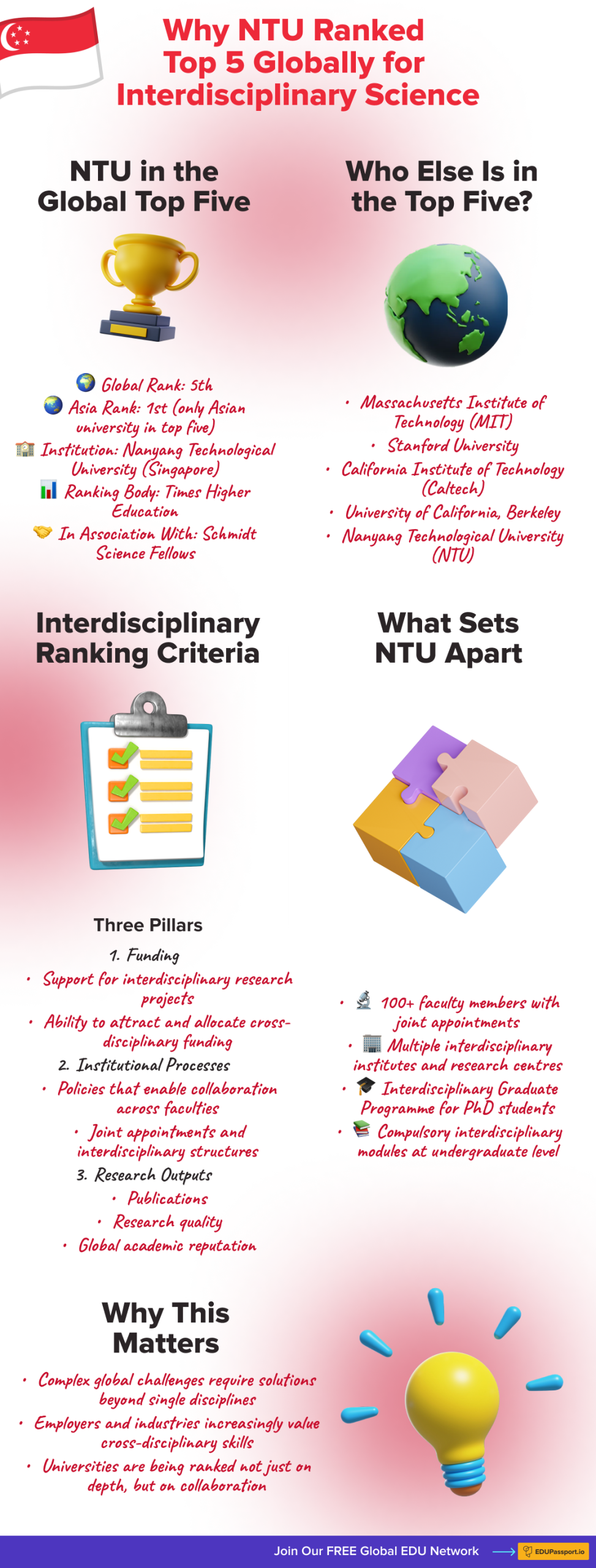






Nanyang Technological University (NTU) has been ranked among the world’s top five universities for interdisciplinary science, becoming the only institution in Singapore and Asia to reach this level of global recognition.
The ranking comes from the latest Times Higher Education (THE) Interdisciplinary Science Rankings, produced in association with Schmidt Science Fellows. NTU placed fifth globally, joining a group dominated by leading US universities, including the Massachusetts Institute of Technology (MIT), Stanford University, the California Institute of Technology, and the University of California, Berkeley.
According to reporting by Find World Edu, the results highlight NTU’s growing influence in interdisciplinary research and education at a time when universities are increasingly being assessed on their ability to work across traditional academic boundaries.
How the rankings are measured
The THE Interdisciplinary Science Rankings assess how effectively universities support and deliver interdisciplinary work. This includes performance across three main areas: funding, institutional processes, and research outputs.
Outputs are evaluated through publications, research quality, and academic reputation, while funding and processes examine how universities structure collaboration across faculties and disciplines. The rankings aim to reflect how well institutions create environments where researchers can combine expertise from different fields to address complex global challenges.
NTU’s strong performance across all areas helped secure its place in the global top five.
Leadership response from NTU
NTU Deputy President and Provost Professor Christian Wolfrum described the ranking as a reflection of the university’s long-term strategy and commitment to interdisciplinary work.
“NTU’s placement in the top five of the Times Higher Education Interdisciplinary Science Rankings is a recognition of how far we have come in interdisciplinary research and education,” he said.
He added that many of today’s most pressing challenges cannot be solved within a single discipline.
“To tackle the toughest challenges in our society and the world, the solutions are found between disciplines and rarely fall within one discipline. Being interdisciplinary is at the heart of this university as we break down walls between disciplines, not just in research but also in education.”
A strong focus on cross-disciplinary research
NTU has invested heavily in interdisciplinary research through a wide network of institutes and research centres that bring together experts from different academic backgrounds. These centres focus on addressing real-world issues such as sustainability, health, advanced manufacturing, and digital technologies.
More than 100 faculty members hold joint appointments across schools or colleges at NTU. This structure allows researchers to draw on expertise from multiple domains and encourages collaboration that would be difficult within traditional academic silos.

This approach has helped NTU strengthen both the scale and impact of its interdisciplinary research output, contributing to its strong showing in the global rankings.
Interdisciplinary learning from undergraduate to PhD level
Interdisciplinary education is not limited to research at NTU. The university has embedded cross-disciplinary learning throughout its academic programmes.
At the postgraduate level, NTU’s Interdisciplinary Graduate Programme allows PhD students to pursue research that spans two or more disciplines. Rather than being confined to a single field, students are encouraged to develop expertise across multiple areas, reflecting the evolving nature of academic and industry research.
At the undergraduate level, students are required to complete Interdisciplinary Collaborative Core modules. These compulsory courses are designed to immerse students early in collaborative, cross-discipline learning and problem-solving.
By introducing interdisciplinary thinking at every stage of education, NTU aims to prepare graduates for careers that increasingly demand flexibility, collaboration, and the ability to integrate knowledge from different fields.
Growing global recognition
NTU’s top-five placement underscores the university’s rising profile in global higher education rankings and reinforces Asia’s growing role in advanced research and innovation.
As international rankings place greater emphasis on interdisciplinary capability, NTU’s model may offer insights for other universities seeking to reform traditional structures and respond to complex global challenges.
The full ranking results were reported by Find World Edu, drawing on data released by Times Higher Education as part of its annual Interdisciplinary Science Rankings.
As global universities like NTU continue to gain recognition for innovation and collaboration, staying informed has never been more important. EDU Passport brings together global education news, international teaching opportunities, and insights from educators worldwide in one trusted hub. Join EDU Passport for FREE to explore what’s happening across borders, discover career pathways, and connect with a global education community shaping the future of learning.