






The United Arab Emirates has removed United Kingdom universities from the list of overseas institutions eligible for state-funded scholarships, a move that is already reshaping study options for Emirati students and raising questions among educators about recognition, mobility, and academic choice.
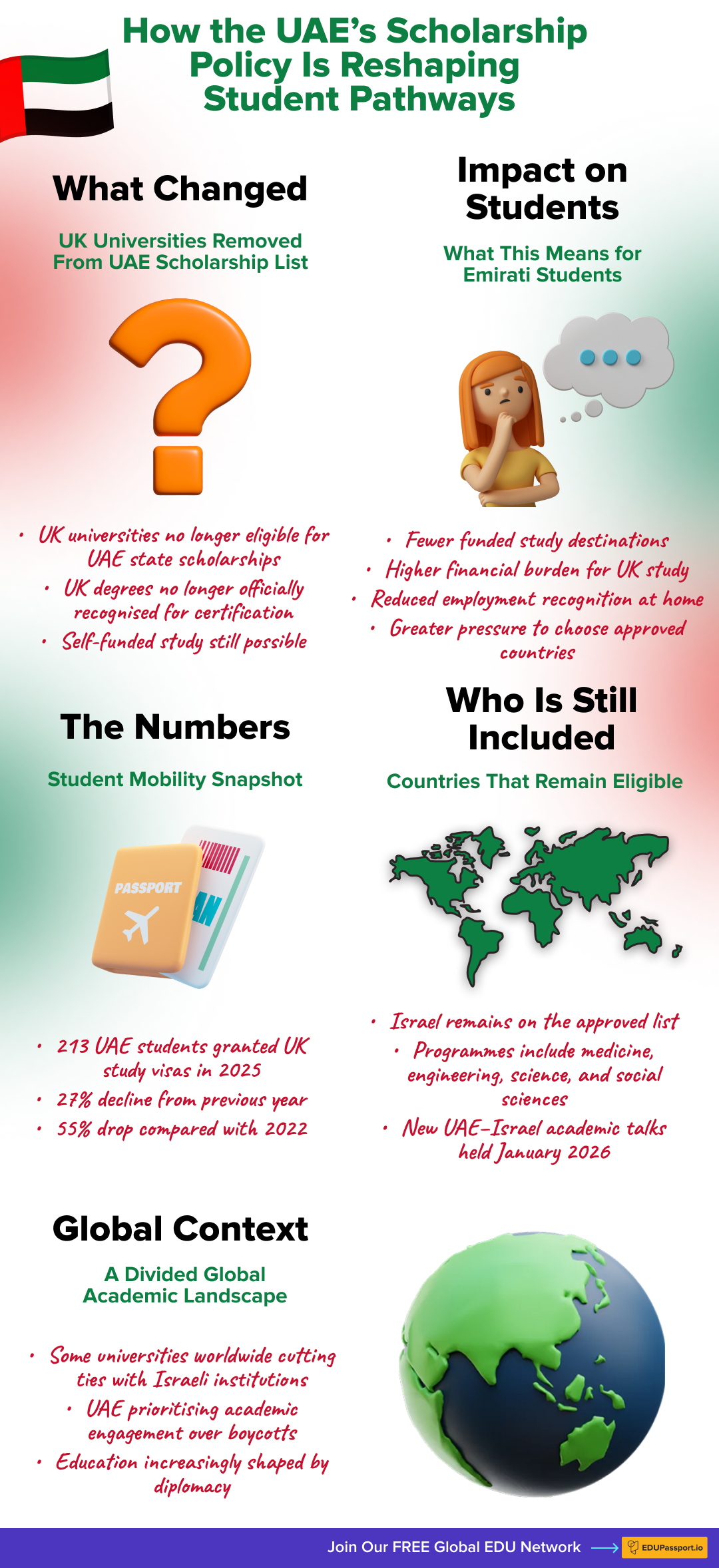
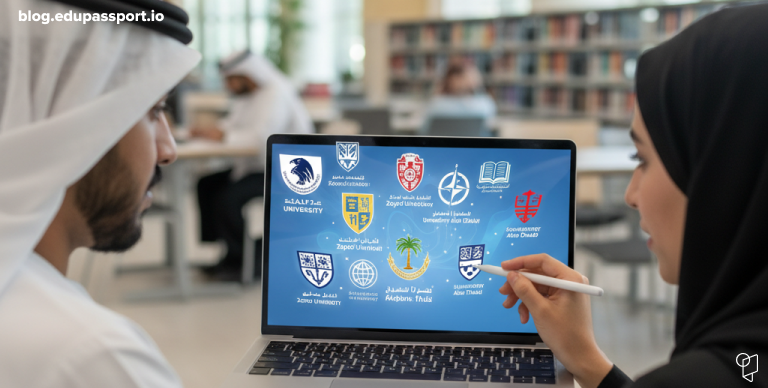
The change emerged publicly last week after the UAE Ministry of Higher Education and Scientific Research (MoHESR) published an updated list of approved global universities whose qualifications qualify for government scholarships and official certification. While the list includes institutions across 42 countries in Asia, Europe, the Americas, Africa, and Oceania, UK universities are no longer included.
The policy shift was first reported by the Financial Times on 8 January and has since been confirmed through MoHESR’s publicly available programme listings. No formal statement explaining the decision has been issued by UAE authorities.
Immediate impact on students
For Emirati students, the decision narrows one of the most popular and historically well-funded study destinations. UK Home Office data already suggests a sharp decline in student mobility. In the year ending September 2025, just 213 students from the UAE were granted visas to study in the UK, a 27% drop compared with the previous year and a 55% fall from 2022.
Educators say the removal goes beyond funding. Because UK universities are no longer on the approved list, their qualifications are no longer formally recognised by UAE authorities, reducing their value in the domestic job market. While students may still choose to study in the UK through self-funding, graduates could face challenges when seeking public sector employment or professional recognition at home.
“This changes how families assess risk,” said one Gulf-based higher education consultant. “A UK degree used to be seen as a safe, prestigious option. Now students have to consider whether it will be recognised when they return.”
Israel remains on the approved list
At the same time, Israeli universities remain eligible for UAE scholarships, a decision that has drawn international attention given the ongoing war in Gaza and the destruction of higher education infrastructure in the territory.
The MoHESR list includes academic programmes at the Hebrew University of Jerusalem and Tel Aviv University across fields such as medicine, engineering, computer science, agriculture, law, economics, and the social sciences.
On 12 January, UAE and Israeli officials held talks aimed at strengthening academic cooperation, with a focus on scientific research, innovation, and knowledge exchange. According to University World News, the discussions highlighted education as a pillar of a knowledge-based economy and long-term development.
This approach aligns with the Abraham Accords, the 2020 agreement that normalised diplomatic relations between the UAE and Israel. The first Emirati student enrolled at an Israeli university in 2021, marking a symbolic shift in regional academic engagement.
A global academic divide
The UAE’s decision contrasts with trends elsewhere. Since the outbreak of the Gaza war, a growing number of universities worldwide have suspended or reconsidered partnerships with Israeli institutions. An Israeli publication cited by University World News reported in November 2025 that academic boycott cases against Israeli universities had doubled since March, particularly in Europe.
Dr Moran Zaga, a Gulf states researcher at the University of Haifa, told University World News that the UAE’s position reflects a belief in engagement over academic isolation.
“From the Emirati perspective, conflict resolution is pursued through dialogue rather than boycotts,” Zaga said, arguing that Israeli universities play a critical role in research, innovation, and internal political debate.
Political context and contested explanations
University World News contacted MoHESR for clarification on the removal of UK universities but received no response.
Neve Gordon, professor of international law and human rights at Queen Mary University of London, suggested the decision may be linked to broader political tensions rather than education quality. He cited disagreements over media ownership, allegations involving UK-based institutions, and the UK government’s refusal to ban the Muslim Brotherhood, which the UAE considers a terrorist organisation.
Similar arguments were echoed publicly by Emirati political analyst Amjad Taha, who claimed on social media that UK universities tolerate extremist influence, allegations the UK government has historically rejected. A UK government review in 2015 found no evidence linking the Muslim Brotherhood to terrorist activity within Britain.
What it means for educators
For UK universities, the decision risks weakening recruitment pipelines from the Gulf and disrupting long-standing academic relationships. For educators in the UAE, it reshapes advising conversations with students who once viewed the UK as a default destination for high-quality education.
Arshin Adib-Moghaddam, professor at SOAS University of London, warned that restricting access to leading UK institutions could be “self-defeating” for students seeking specialised academic environments.
“Universities thrive when they are dislodged from political agendas,” he told University World News. “Limiting students’ exposure to diverse academic traditions ultimately narrows intellectual development.”
At the same time, Gordon argued the decision underscores a long-standing reality: higher education is deeply intertwined with politics.
“Countries have always used higher education to advance domestic and international priorities,” he said.
A shifting landscape for student mobility
As global higher education becomes increasingly shaped by diplomacy, conflict, and ideology, students are left navigating a more complex landscape. For Emirati learners, the removal of UK universities from the scholarship system signals not just a funding change, but a broader redefinition of which academic pathways are encouraged, recognised, and rewarded.
For educators worldwide, the move highlights a growing truth: access to education is no longer determined by academic merit alone, but by the shifting alliances that surround it.
Navigating changing study policies can be overwhelming.
Join EDU Passport to explore verified study and teaching opportunities worldwide, get clarity on degree recognition, and stay informed as global education pathways shift.