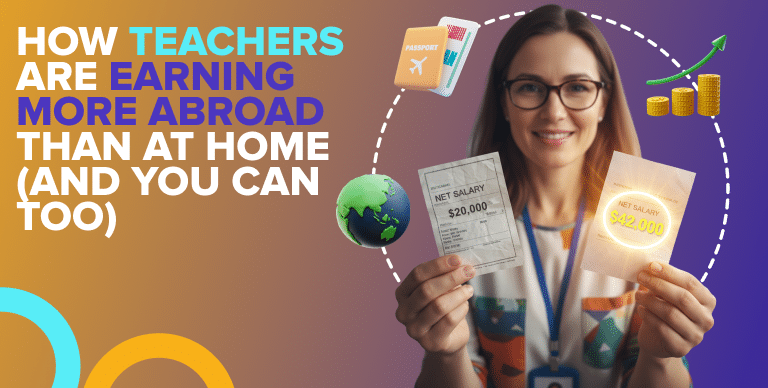






Earning $4000 a month as a teacher sounds ambitious, but in the international education market, it is absolutely possible.
The key difference is this: not all teaching jobs are equal.
While many local teaching roles offer modest salaries, international schools in certain countries provide significantly higher compensation, often combined with housing, flights, and tax advantages. The result is a total package that can reach or exceed $4000 per month.
However, this level is not automatic. It depends on where you go, the type of school, and how well you position yourself.
This guide breaks down the real numbers, country by country.
What “$4000/Month” Actually Means
Before looking at specific countries, it is important to understand what this number represents.
In many cases, $4000 is not just base salary. It often includes additional benefits such as housing allowances, medical insurance, and annual flights. In tax-free regions, the take-home value can be even higher.
This means two teachers in the same country can earn very different amounts depending on their school and package.
United Arab Emirates (UAE)
The UAE remains one of the strongest markets for high-paying teaching jobs, particularly in Dubai and Abu Dhabi.
Salary data from international teaching platforms such as Wondering Staffroom shows that teachers typically earn between AED 12,000 and AED 21,000 per month (approximately $3,200–$5,700).
Most international schools also provide housing or a housing allowance, along with flights and medical insurance.
👉 Reality check:
Reaching $4000/month is realistic here, especially in mid- to top-tier schools with at least a few years of experience.
Qatar
Qatar offers competitive salaries combined with strong benefit packages.
Teachers generally earn between QAR 9,000 and QAR 16,000 per month (~$2,400–$4,400), with some positions reaching up to QAR 20,000 (~$5,400) in top schools, based on data from platforms like Wondering Staffroom and IQTS.
Housing and additional benefits are commonly included.
👉 Reality check:
$4000/month is achievable, but typically at the higher end of the market.
Saudi Arabia
Saudi Arabia consistently ranks among the highest-paying countries for teachers.
While salary ranges vary widely, experienced teachers in international schools can earn packages exceeding $4000/month, especially when tax-free income and benefits are included.
The overall savings potential is particularly high due to lower living costs in many cities.
👉 Reality check:
One of the best countries for maximizing savings, not just income.
China
China has rapidly become one of the most competitive markets for international educators. According to data from China-focused teaching platforms, salaries in international schools typically range between 28,000 and 45,000 RMB per month (around $3,800–$6,200).
Demand remains high, especially in major cities and for subjects like math and science.
👉 Reality check:
One of the few countries where earning $4000/month is relatively common for qualified teachers.
Singapore
Singapore offers high salaries alongside a strong professional environment. Teachers in international schools can earn around $3,000 to $5,000+ per month, depending on experience and the institution. While the cost of living is higher, compensation is designed to match it.
👉 Reality check:
$4000/month is achievable, but competition is strong and expectations are high.
Hong Kong
Hong Kong is known for offering premium teaching packages, particularly in established international schools. Salaries often exceed $4,000 per month, and many schools provide housing allowances, which significantly increase total compensation.
👉 Reality check:
High earning potential, but also one of the most competitive markets.
What Separates Teachers Who Reach $4000+
Reaching this level is less about luck and more about positioning.
Teachers who consistently land higher-paying roles tend to have:
- A recognized teaching qualification
- At least 2–5 years of experience
- Clear, measurable achievements
- Experience with international curricula
Just as importantly, they present their experience in a way that is easy for schools to evaluate quickly.
The Hidden Factor: How You Present Your Profile

Here is something many teachers overlook:
Schools are not just selecting the best candidates. They are selecting the clearest candidates.
When your experience is scattered across multiple documents, it creates friction. Recruiters have to work harder to understand your value, and in a competitive market, they often will not.
That is why more educators are moving toward structured professional profiles that present everything in one place. It makes your application easier to trust, easier to review, and more likely to be shortlisted.
Common Mistakes That Limit Your Earning Potential
Many teachers never reach higher salary levels, not because they lack ability, but because of avoidable mistakes.
Applying to lower-tier schools, focusing only on base salary, or presenting a generic profile can significantly reduce your chances. In some cases, strong candidates are overlooked simply because their value is not clearly communicated.
Avoiding these pitfalls can make a significant difference.
Conclusion
There are clear countries where teachers can earn $4000/month or more, but this level is not guaranteed. It depends on choosing the right markets, targeting the right schools, and presenting yourself in a way that stands out.
When you combine the right qualifications with a strong, well-structured profile, these opportunities become far more accessible.
If you are serious about reaching this level, the next step is not just applying more, but positioning yourself better. Build a professional profile with EDU Passport and make it easier for top schools to find and shortlist you.